The Core Role of Hydraulic Cylinders in Truck Crane Operations
Every truck crane on a job site depends on a reliable set of hydraulic cylinders to convert fluid pressure into precise linear force. These actuators serve as the muscles behind every lift, every boom extension, and every outrigger deployment. Without a properly sized and manufactured crane hydraulic cylinder, even the most advanced mobile crane cannot perform safely or efficiently.
A truck crane hydraulic cylinder fulfills several critical functions simultaneously. The luffing hydraulic cylinder controls the boom angle, raising or lowering the main arm to position loads at varying heights. Hydraulic horizontal cylinders manage telescopic boom extension, enabling the crane to reach across wide spans without repositioning the entire vehicle. The counterweight hydraulic cylinder adjusts ballast positioning to maintain stability under shifting loads. And the support leg hydraulic cylinder deploys outrigger legs that anchor the crane firmly to the ground during heavy lifts.
For fleet managers and equipment owners operating in demanding environments across Mexico and Latin America, selecting the right hydraulic cylinder for truck crane applications directly impacts uptime, maintenance costs, and operator safety. A well-engineered mobile crane hydraulic cylinder reduces the frequency of seal replacements, resists corrosion from humid or coastal environments, and maintains consistent performance across thousands of duty cycles.
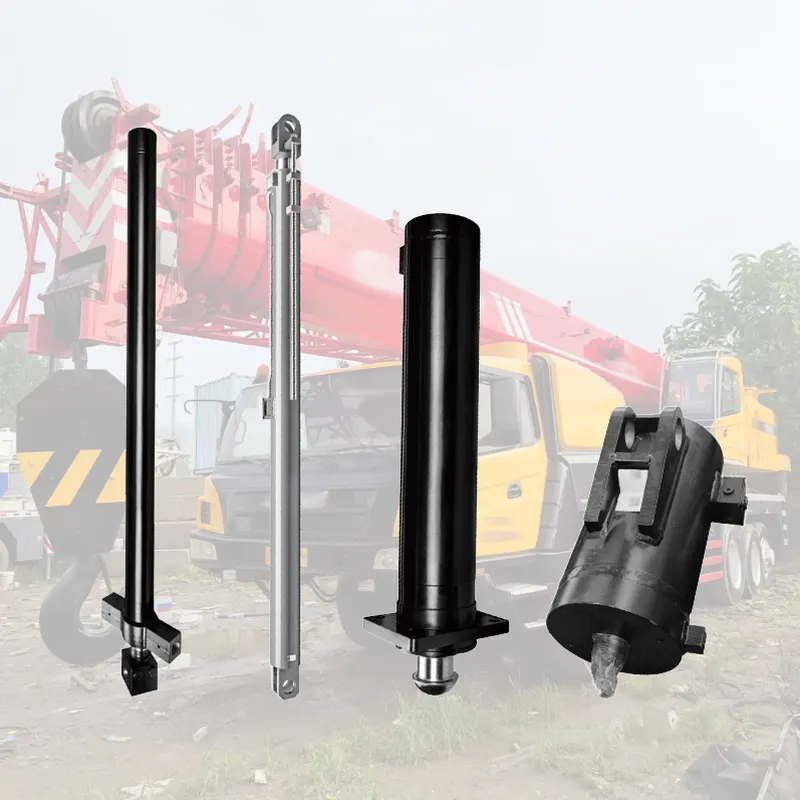
The value proposition goes beyond mechanical function. A premium hydraulic cylinder built with tight tolerances and quality materials translates directly into reduced total cost of ownership. Fewer unplanned shutdowns, lower fluid consumption, and extended service intervals all contribute to a measurable return on investment that fleet operators notice within the first year of operation.
Technical Specifications and Customizable Parameters
When sourcing truck crane hydraulic cylinders, understanding the full range of configurable parameters is essential. Each crane model and application scenario demands a specific combination of bore diameter, stroke length, operating pressure, and mounting configuration. The tables below outline the customizable specification ranges available across our product lines, including hydraulic luffing cylinders, hydraulic horizontal cylinders, hydraulic counterweight cylinders, and hydraulic support leg cylinders.
Basic Specification Ranges
| Parameter | Customizable Range | Notes |
|---|---|---|
| Bore Diameter | 50 mm – 400 mm | Sized per crane tonnage and required thrust |
| Rod Diameter | 30 mm – 280 mm | Typically 0.5 – 0.7 x bore diameter |
| Stroke Length | 200 mm – 12,000 mm | Custom lengths available for telescopic stages |
| Operating Pressure | 16 MPa – 35 MPa | Standard 25 MPa; heavy-duty up to 35 MPa |
| Burst Pressure | Up to 70 MPa | Minimum 2x rated working pressure |
| Cylinder Type | Single acting / Double acting / Telescopic | Application dependent |
| Extension Speed | 50 – 500 mm/s | Adjustable via flow control valves |
| Force Output | 50 kN – 2,000 kN | Calculated from bore and pressure |
Mounting Options
| Mounting Style | Application Suitability |
|---|---|
| Clevis (MS4) | Boom luffing, general articulation joints |
| Trunnion (MT4) | Heavy-load boom cylinders with fixed pivot |
| Flange (MP1 – MP4) | Outrigger and stabilizer systems |
| Foot Mount (MF5 – MF6) | Horizontal telescopic sections |
| Cross Tube / Pin Eye | Support leg and counterweight cylinders |
Materials and Surface Treatment
| Component | Material / Treatment |
|---|---|
| Cylinder Tube | High-tensile seamless steel tube (yield strength 355+ MPa), honed bore finish Ra 0.2 – 0.4 um |
| Piston Rod | 42CrMo / CK45 chrome-plated steel, hard chrome 20 – 30 um thickness |
| Piston | Ductile iron or forged alloy steel, induction hardened |
| Seals | Parker / Hallite / NOK-grade polyurethane and PTFE composite seals |
| Surface Coating | Optional nickel-chrome plating, QPQ salt bath nitriding, or ceramic coating |
| End Caps / Glands | Forged steel or ductile iron, CNC machined |
Environmental Adaptability
| Parameter | Range |
|---|---|
| Operating Temperature | -40 C to +120 C |
| Salt Spray Resistance (NSS) | Grade 9 / 96+ hours |
| Dust and Particle Protection | Metal scraper + polyurethane wiper seal |
| Hydraulic Fluid Compatibility | Mineral oil, biodegradable (HETG/HEES), water glycol |
| Cleanliness Standard | NAS 1638 Class 8 or ISO 4406 16/14/11 |
| Cycle Life (tested) | 200,000+ full-stroke cycles |
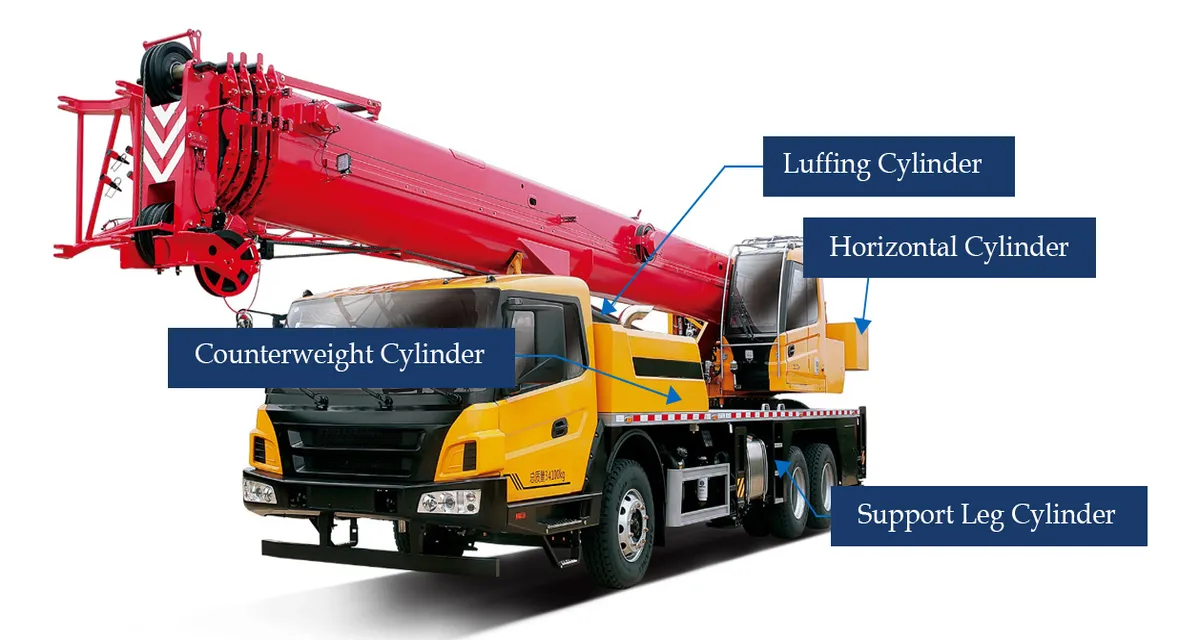
How a Truck Crane Hydraulic Cylinder Works
The operating principle behind every hydraulic cylinder for crane applications is rooted in Pascal’s Law: pressure applied to a confined fluid is transmitted equally in all directions. In practical terms, a hydraulic pump pressurizes fluid (typically mineral-based hydraulic oil) and directs it into the cylinder barrel through ported connections. This pressurized fluid acts upon the hydraulic cylinder piston, generating a linear pushing force that extends the piston rod outward.
In a double acting hydraulic cylinder, fluid can be directed to either side of the piston. When pressurized fluid enters the cap-end port, the piston rod extends, producing the primary thrust used for lifting, luffing, or extending the crane boom. When fluid is directed to the rod-end port, the piston retracts, pulling the boom inward or lowering the load under controlled hydraulic resistance. This bidirectional control is what gives a truck crane operator precise authority over load positioning.
A single acting hydraulic cylinder, commonly found in support leg and outrigger systems, uses hydraulic pressure for extension only. Retraction occurs through gravity or spring return once the hydraulic pressure is released. This simpler design reduces weight and cost in applications where controlled retraction force is not critical.
For multi-stage boom telescoping, telescopic cylinders use nested barrel sections that extend sequentially. Each stage has its own piston and seal assembly, enabling a long total stroke from a compact retracted length. This design is standard in truck-mounted cranes where transport height restrictions limit the retracted boom length.
The critical performance factors in this system are the hydraulic cylinder seals, which must prevent both internal and external leakage under high pressure and temperature cycles; the bore surface finish, which must be smooth enough to protect seal integrity over hundreds of thousands of cycles; and the rod surface hardness, which must resist scoring from dust, debris, and side-loading forces common in field conditions.
Compatible Replacement for Major Crane Brands
Note: All third-party brand names mentioned below are the property of their respective owners. They are referenced solely to help buyers identify compatible replacement hydraulic cylinders for their specific equipment and do not imply any affiliation, endorsement, or sponsorship.
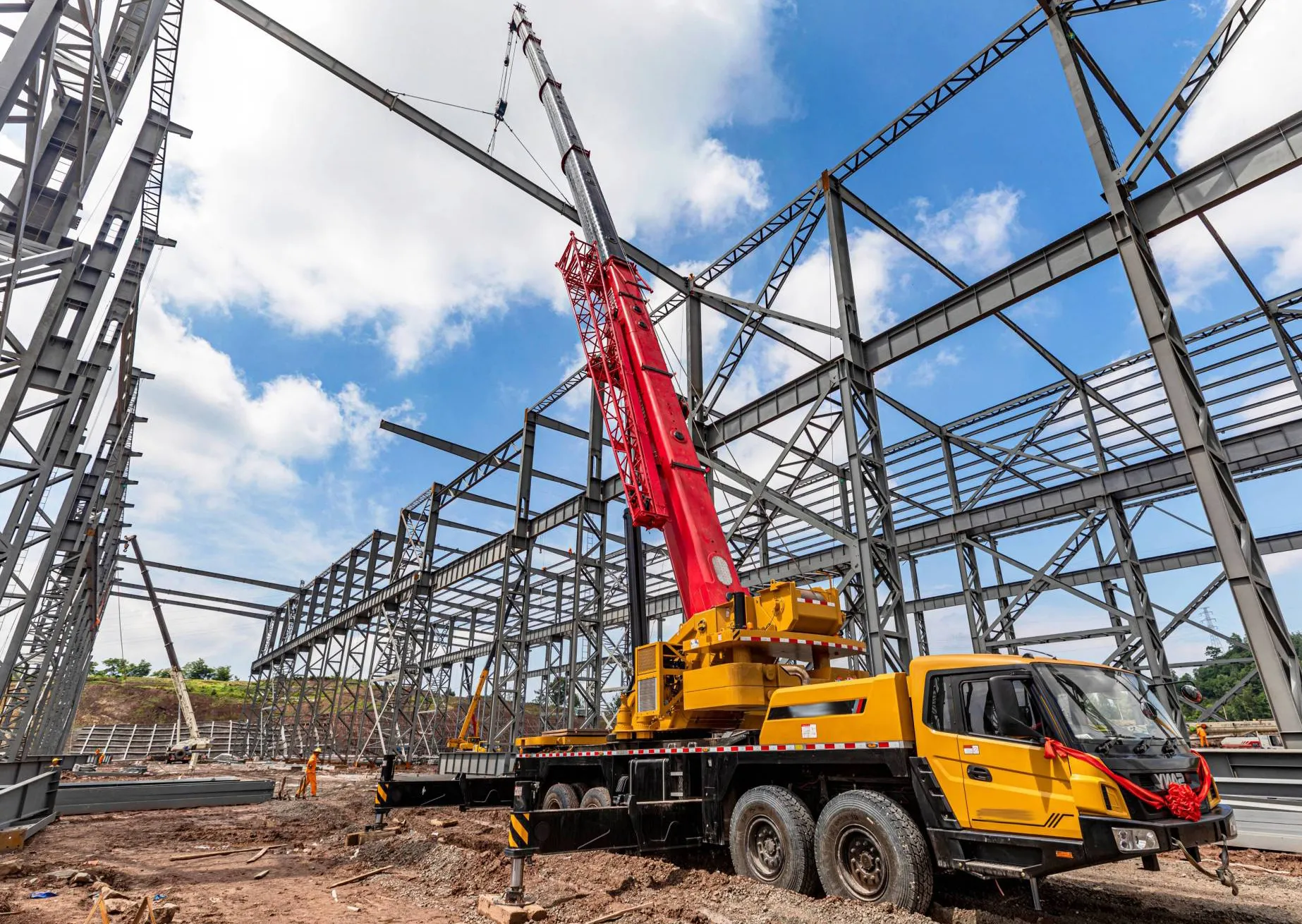
Our truck crane hydraulic cylinders are engineered as direct-fit or adaptable replacements for cylinders installed on a wide range of globally recognized crane platforms. If you operate any of the following brands, our cylinders can be manufactured to match or exceed the original equipment specifications:
- XCMG (QY series, XCT series truck cranes)
- Zoomlion (ZTC, QY series mobile cranes)
- Sany (STC series truck cranes)
- Liebherr (LTM, LTF series)
- Tadano (GR, GT series rough terrain and truck cranes)
- Manitowoc / Grove (GMK, GHC series)
- Terex / Demag (AC series all-terrain cranes)
- KATO (NK, CR series)
- Kobelco (CKE series)
- Palfinger (truck-mounted knuckle boom cranes)
- PM Group (articulated cranes)
Whether you need a replacement hydraulic luffing cylinder, a new counterweight hydraulic cylinder, or a complete set of outrigger hydraulic cylinders for sale, our engineering team can cross-reference OEM part numbers and dimensional drawings to deliver a cylinder that drops into your existing crane structure with zero modification.
Core Technical Advantages
Ultra-Low Friction Sealing Technology
Our sealing systems use a combination of stepped PTFE guide rings and low-friction polyurethane piston seals that reduce breakaway pressure by up to 30% compared to standard NBR seal sets. Lower friction means smoother cylinder response, less heat generation during rapid cycling, and significantly extended seal service life. For operators running cranes in continuous-duty applications such as port logistics or wind turbine erection, this translates to measurably lower maintenance frequency.
High-Rigidity Cylinder Barrel and Piston Rod Manufacturing
Each cylinder barrel is deep-hole bored, honed to Ra 0.2 – 0.4 um surface finish, and stress-relieved before final machining. Piston rods are manufactured from 42CrMo alloy steel, induction hardened, precision ground, and plated with industrial-grade hard chrome (minimum 20 um thickness). This combination delivers superior buckling resistance for long-stroke applications and consistent bore-to-rod concentricity that protects seals from uneven wear.
Thermal Stability and Fatigue Life Optimization
Truck cranes in hot climates like Mexico, the Middle East, or equatorial regions face continuous thermal stress. Our cylinders are designed with controlled clearance tolerances that accommodate thermal expansion without binding or internal leakage. Combined with heat-stabilized seal compounds rated to +120 C continuous duty, the result is a hydraulic cylinder that maintains rated performance across wide temperature swings without degradation.
Integrated Cushioning for Shock Absorption
End-of-stroke cushioning is engineered into each cylinder to decelerate the piston before it reaches the end cap. This reduces hydraulic shock loads on the cylinder structure, minimizes pressure spikes in the hydraulic circuit, and protects downstream components such as valves and hose fittings from premature fatigue. Adjustable cushioning screws allow fine-tuning in the field.
Contamination-Resistant Design
Every rod gland assembly includes a metal scraper ring paired with a polyurethane wiper seal to prevent abrasive particles from entering the cylinder bore. Internal fluid channels are designed with laminar flow geometry to reduce turbulence and particle migration. Post-assembly, each cylinder is flushed to NAS 1638 Class 8 cleanliness before shipping.
Corrosion Protection for Coastal and Marine Environments
For cranes operating in port facilities, offshore platforms, or coastal regions, we offer enhanced corrosion protection packages. These include QPQ (quench-polish-quench) salt bath nitriding on piston rods, nickel-chrome duplex plating on cylinder barrels, and marine-grade paint systems on external surfaces. Our standard rod chrome plating passes 96+ hours of neutral salt spray testing without pitting.
Manufacturing Process and Quality Control
Full In-House Manufacturing
From raw material receiving through final assembly, every stage of production takes place under one roof. Steel tubes are cut, bored, and honed on dedicated production lines. Piston rods are turned, ground, and chrome-plated using automated CNC equipment. Pistons, end caps, and glands are CNC machined from forgings and castings. Welding operations follow WPS-qualified procedures with full penetration weld inspection. This vertical integration gives us complete control over dimensional accuracy, surface quality, and lead time.
100% Factory Testing Before Shipment
No hydraulic cylinder leaves our facility without undergoing a comprehensive test protocol. Each unit is pressure-tested at 1.5x rated working pressure to verify structural integrity. Leakage tests confirm both internal bypass and external seal performance. Stroke function tests verify smooth extension and retraction across the full stroke under load. For critical or custom orders, we provide certified test reports with pressure-time graphs and dimensional inspection data.
Certifications and Full Traceability
Our manufacturing facility holds ISO 9001:2015 quality management certification. Raw material batches are traceable to mill certificates, and each finished cylinder carries a unique serial number linked to its complete production and test history. We can supply EN 10204 3.1 material certificates, third-party NDT reports, and dimensional inspection records upon request.
Continuous Improvement Through Data
Field return data, warranty claim records, and customer feedback are systematically analyzed to drive design and process improvements. When a specific seal configuration shows higher-than-expected replacement rates in a particular climate zone, we work with our seal suppliers to develop a targeted solution. This commitment to ongoing optimization is what separates a true hydraulic cylinder manufacturer from a simple parts distributor.
Typical Industry Applications
Construction Industry
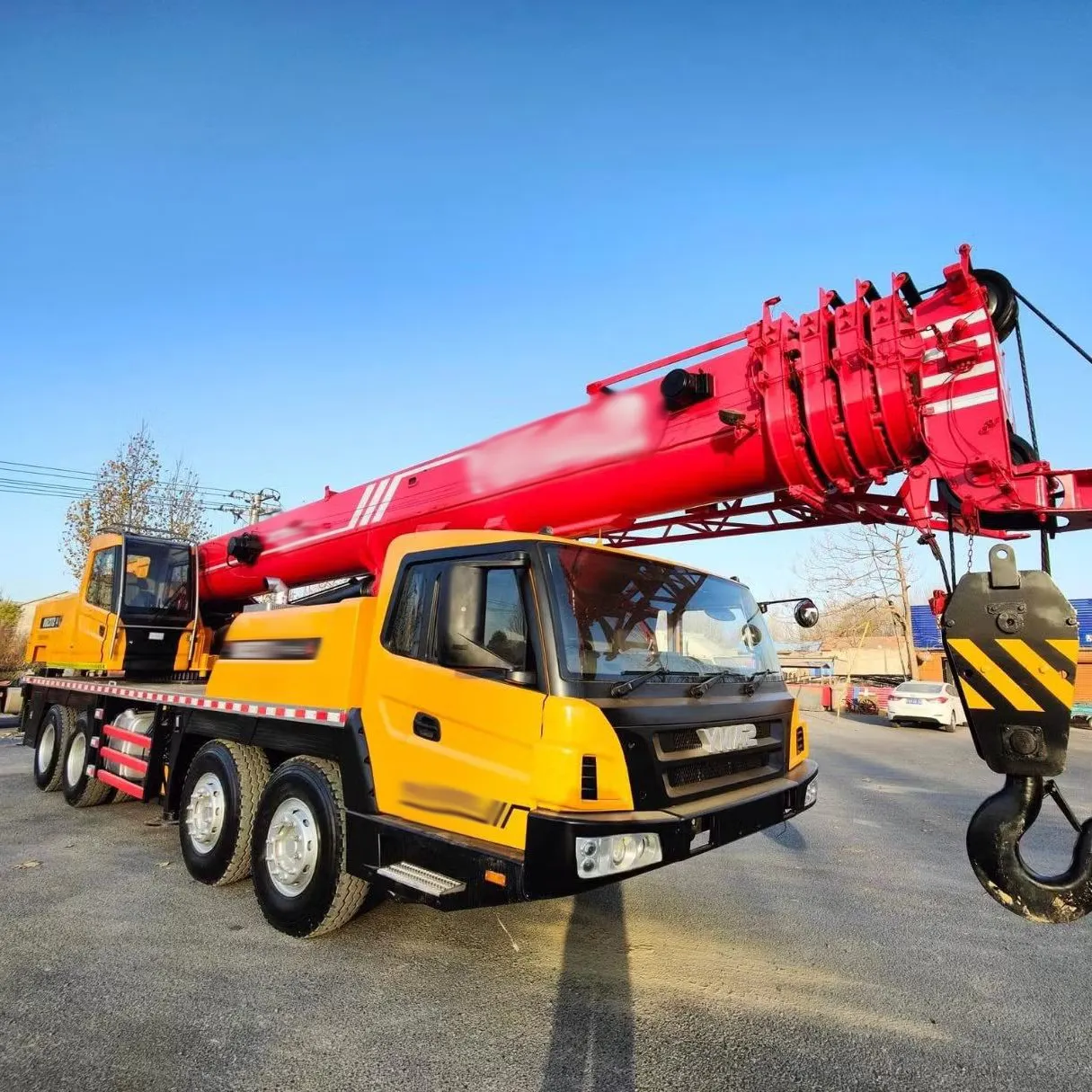
Truck cranes are indispensable on building sites for steel structure erection, precast concrete panel placement, and heavy equipment positioning. The hydraulic cylinders powering these cranes must withstand repetitive duty cycles with heavy loads, often in dusty or muddy conditions. Our cylinders feature reinforced scraper systems and hardened rod surfaces to maintain performance in these environments.
Ports and Maritime Industry
Port operations demand rapid cycle times and high reliability. Mobile cranes used for container handling, ship repair, and cargo transfer rely on crane hydraulic cylinders that resist saltwater corrosion and perform consistently under sustained high-duty operation. Our marine-grade cylinders with enhanced chrome plating and corrosion-resistant coatings are proven in port environments from Veracruz to Manzanillo.

Mining and Quarrying Industry
In mining operations, truck cranes handle heavy drilling equipment, structural components, and overburden materials. The extreme vibration, abrasive dust, and wide temperature variations common in mines demand cylinders built with extra-thick chrome plating, heavy-duty seals, and reinforced mounting hardware.
Oil and Gas Industry
From wellhead servicing to pipeline construction, truck cranes in the oil and gas sector face unique challenges including exposure to hydrogen sulfide, methane, and harsh desert or offshore conditions. Our cylinders can be specified with special seal compounds and rod coatings designed for chemical resistance and extreme temperature cycling.
Manufacturing Industry
Inside manufacturing plants, truck cranes and car cranes move heavy machinery, raw materials, and oversized assemblies. Indoor environments reduce corrosion risk but increase the demand for precise, low-speed cylinder control and quiet operation. Our cylinders with cushioned end-of-stroke design are well suited for these applications.
Transportation and Logistics Industry
Truck-mounted cranes used by logistics companies for loading and unloading cargo containers, heavy crates, and industrial equipment require compact, high-force hydraulic cylinders that fit within the vehicle frame envelope. Our hydraulic cylinder for car crane and light truck crane models deliver full performance from a reduced-footprint design.
Energy and Utilities Industry
Wind turbine installation, power line maintenance, and transformer replacement projects all depend on truck cranes with long-reach boom capability. The hydraulic horizontal cylinders that drive telescopic boom extension must deliver smooth, judder-free movement even at full extension under load. Our cylinders achieve this through precision-honed bore surfaces and engineered bearing band systems.
Forestry and Logging Industry
Log loading and timber transport operations subject cranes to high shock loads, rapid cycling, and heavy contamination from wood resin, bark, and moisture. Our heavy-duty wiper and scraper systems, combined with impact-resistant mounting hardware, keep the cylinder sealed and functioning in these demanding conditions.
Agriculture Industry
Modern agricultural operations use truck cranes for grain silo maintenance, irrigation equipment installation, and heavy implement relocation. Seasonal use patterns mean these cylinders must resist corrosion during storage periods. Our corrosion-inhibitor-compatible seal materials and optional rod protective sleeves address this requirement.
Explore our full range of crane hydraulic cylinders to find the right configuration for your specific industry application.

Standard Hydraulic Cylinders vs. Our High-Perormance Cylinders
| Feature | Standard Cylinder | Our High-Performance Cylinder |
|---|---|---|
| Bore Surface Finish | Ra 0.6 – 0.8 um | Ra 0.2 – 0.4 um (mirror honed) |
| Rod Chrome Thickness | 10 – 15 um | 20 – 30 um |
| Seal Type | Standard NBR | Low-friction PTFE / PU composite |
| Cycle Life | 80,000 – 100,000 cycles | 200,000+ cycles |
| Cleanliness Rating | NAS 1638 Class 10 – 12 | NAS 1638 Class 8 |
| End-of-Stroke Cushioning | Not included | Adjustable cushioning standard |
| Salt Spray Resistance | 48 hours | 96+ hours |
| Factory Testing | Spot check sampling | 100% pressure and function tested |
| Temperature Range | -20 C to +80 C | -40 C to +120 C |
| Warranty | 6 – 12 months | 18 – 24 months |
Real-World Project Case Studies
Case 1: Port Container Handling Upgrade in Lazaro Cardenas, Mexico
Client: A Mexican port logistics company operating 8 truck-mounted cranes (XCMG QY25K5-I)
Challenge: The original luffing hydraulic cylinders were showing premature seal failure after only 14 months of service due to the high-humidity, salt-air environment along the Pacific coast. Downtime for each cylinder replacement was costing the operation roughly 12 hours per incident.
How They Found Us: Their maintenance supervisor searched online for alternative hydraulic cylinder manufacturers with marine-grade corrosion packages and contacted our sales team through the website contact form in March 2024.
Solution: We supplied 16 replacement luffing cylinders with QPQ-treated rods, PTFE composite seals, and enhanced wiper assemblies. Dimensions matched OEM specifications exactly.
Result: After 18 months of operation (as of September 2025), zero seal failures reported. The client estimated a 40% reduction in hydraulic maintenance labor hours across their fleet.
“We expected maybe a small improvement. What we got was a complete elimination of the seal leak problem that had been plaguing our fleet for years. The cylinders from CylindersHydraulic simply perform at a different level.” – Maintenance Director, Port Operations
Case 2: Wind Farm Installation in Oaxaca, Mexico
Client: A renewable energy contractor deploying 50-ton truck cranes for wind turbine nacelle and blade installation
Challenge: The existing telescopic boom cylinders were unable to deliver smooth, controlled extension at heights above 60 meters, causing operator concern and reduced productivity. Temperature swings between 10 C at night and 42 C during midday were accelerating seal degradation.
How They Found Us: Their procurement engineer was referred by a Sany dealer who had used our products for aftermarket service in Asia. They reached out via email in June 2024.
Solution: We engineered a set of 4-stage telescopic hydraulic cylinders with heat-stabilized FKM seals and integrated cushioning at each stage transition. The bore surface was honed to Ra 0.2 um for maximum seal longevity.
Result: Turbine installation rate increased from 1.5 turbines per week to 2.1 turbines per week. The contractor reported zero cylinder-related downtime through the first 11 months.
“The boom extends like butter now, even at full height in 40-degree heat. Our operators noticed the difference on day one.” – Site Project Manager
Case 3: Mining Operation in Sonora, Mexico
Client: A copper mining company operating a fleet of 12 mobile cranes (mixed XCMG and Tadano models)
Challenge: Abrasive copper dust was penetrating the existing cylinder rod seals within 6-8 months, causing internal contamination and progressively worsening hydraulic drift under load. Each cylinder overhaul took 3 days and required flying in OEM parts.
How They Found Us: The fleet manager attended a mining equipment trade show in Monterrey in November 2023 and visited our booth. After reviewing sample cylinders and test data, he placed a trial order for 4 units.
Solution: We supplied support leg hydraulic cylinders and luffing cylinders with triple-lip wiper seals, ceramic-coated rods, and heavy-duty metal scraper rings. All cylinders were supplied with hydraulic cylinder parts kits for field-level seal replacement.
Result: Seal replacement interval extended from 6 months to over 20 months. The mining company subsequently ordered cylinders for their entire fleet across three mine sites.
“The dust here destroys everything. These cylinders are the first ones that actually lasted. We have standardized on CylindersHydraulic across all our crane equipment.” – Fleet Maintenance Manager
Case 4: Infrastructure Project in Guadalajara, Mexico
Client: A civil engineering firm working on highway overpass construction using 70-ton and 100-ton truck cranes
Challenge: Project timelines were being extended due to inconsistent crane performance. The counterweight hydraulic cylinders on two cranes had developed slow internal leakage, reducing effective lifting capacity by approximately 15%. OEM lead times for replacement cylinders were quoted at 16 weeks.
How They Found Us: The project director contacted us through a LinkedIn connection in February 2025, requesting an urgent quotation with a 4-week delivery timeline.
Solution: We fast-tracked production of 4 counterweight cylinders and 4 horizontal hydraulic cylinders matching Zoomlion ZTC1000V specifications. All cylinders were delivered, inspected, and installed within 3.5 weeks.
Result: Full lifting capacity was restored. The project returned to schedule, and the firm avoided an estimated $180,000 USD in delay penalties.
“Three and a half weeks from purchase order to installed and tested. That kind of responsiveness saved our project timeline and our budget.” – Senior Project Director
Case 5: Oil Refinery Maintenance in Tabasco, Mexico
Client: An industrial services contractor providing crane rental for PEMEX refinery turnaround projects
Challenge: H2S (hydrogen sulfide) exposure was corroding piston rods on their 25-ton truck crane fleet, causing pitting that led to premature seal wear. Standard chrome plating was degrading within 4-6 months of continuous refinery-site deployment.
How They Found Us: A hydraulic system integrator in Villahermosa recommended our products in August 2024 after using our cylinders on another industrial project.
Solution: We supplied a complete set of boom luffing and support leg cylinders with nickel-chrome duplex rod plating and FKM seal compounds rated for H2S exposure. The cylinder barrels received a zinc-rich epoxy primer with polyurethane topcoat.
Result: After 14 months in refinery service, rod surface inspection showed zero pitting. The contractor extended their cylinder replacement cycle from annual to biennial, halving their cylinder procurement costs.
“H2S eats everything down here. These rods still look new after a full turnaround season. That has never happened with any other supplier.” – Operations Manager
Common Fault Diagnosis and Troubleshooting
External Oil Leakage at Rod Seal
Possible Causes: Worn or damaged rod seal, scored piston rod surface, contamination buildup behind wiper seal, or excessive side loading on the rod.
Corrective Action: Inspect the rod surface for scoring or chrome damage. Replace the seal kit using genuine hydraulic cylinder seals. If the rod is damaged, re-chrome or replace the rod assembly. Check alignment to eliminate side-loading.
Cylinder Drift Under Load (Internal Leakage)
Possible Causes: Worn piston seals allowing internal bypass, scored cylinder bore, or contaminated hydraulic fluid degrading seal integrity.
Corrective Action: Perform a bypass leakage test by pressurizing one port with the other open to a measuring container. If leakage exceeds the manufacturer specification, replace piston seals. If the bore is scored, the cylinder may require re-honing or barrel replacement.
Slow or Jerky Cylinder Movement
Possible Causes: Air trapped in the hydraulic circuit, insufficient hydraulic flow, partially blocked ports, or worn guide rings causing metal-to-metal contact.
Corrective Action: Bleed air from the circuit by cycling the cylinder slowly through full stroke with bleed valves open. Check pump flow rate and filter condition. Inspect guide rings and bearing bands for wear.
Abnormal Noise During Operation
Possible Causes: Cavitation from restricted suction lines, loose mounting hardware, worn bearing bands allowing piston-to-bore contact, or aerated hydraulic fluid.
Corrective Action: Check suction line diameter and filter restriction. Torque all mounting bolts to specification. Inspect internal hydraulic cylinder components for wear patterns. Verify hydraulic fluid level and condition.
Rod Bending or Buckling
Possible Causes: Exceeding the cylinder rated load in compression mode, insufficient rod diameter for the stroke length, or misalignment between cylinder and load attachment points.
Corrective Action: Verify the actual operating load does not exceed the Euler buckling limit for the installed rod diameter and stroke. Correct any mounting misalignment. If recurrent, specify a larger rod diameter for the replacement cylinder.

How to Select the Right Hydraulic Cylinder for Your Truck Crane
Choosing the correct hydraulic cylinder for truck crane applications involves matching multiple technical parameters to your specific crane model, operating conditions, and performance requirements. Here is a practical selection framework:
Step 1 – Define the Application: Identify which function the cylinder will perform: luffing, telescoping, outrigger stabilization, or counterweight adjustment. Each function has distinct force, speed, and stroke requirements.
Step 2 – Determine Force Requirements: Calculate the maximum force needed using the formula: Force = Pressure x Piston Area. Include a safety factor of 1.5 to 2.5 times the theoretical maximum load. This calculation determines the required bore diameter at your system operating pressure.
Step 3 – Specify Stroke Length: Measure the full range of linear motion required. For boom luffing cylinders, this is the distance between the boom full-down and full-up positions measured along the cylinder mounting centerline. For telescopic stages, each nested barrel section defines a stroke stage.
Step 4 – Check Rod Buckling Limits: For cylinders operating in compression (pushing) mode, verify that the rod diameter and stroke length combination does not exceed the Euler critical buckling load for the mounting configuration. Rod end fixity conditions (pinned-pinned, fixed-pinned, fixed-fixed) significantly affect allowable rod loads.
Step 5 – Select Mounting Style: Match the mounting type to your crane structure. Clevis mounts allow angular movement and are standard for luffing applications. Trunnion mounts provide rigid centerline support for heavy boom cylinders. Flange and foot mounts suit fixed-axis applications like outriggers.
Step 6 – Specify Environmental Requirements: Coastal, desert, arctic, or chemically aggressive environments each demand specific seal materials, rod coatings, and paint systems. Communicate your operating environment to the manufacturer so the cylinder can be specified accordingly.
Step 7 – Verify Port Connections: Ensure the cylinder port size, thread type (SAE, BSPP, or metric), and location match your hydraulic circuit. Mismatched ports require adapters that can introduce leak points and flow restrictions.
If you need assistance with cylinder selection or sizing, our engineering team is available to review your requirements and recommend the optimal configuration.

Frequently Asked Questions
What is the typical lead time for custom truck crane hydraulic cylinders?
Standard production lead time for custom truck crane hydraulic cylinders ranges from 3 to 6 weeks depending on bore size, stroke length, and any special surface treatments required. Rush orders with expedited manufacturing can be accommodated in as few as 2 to 3 weeks for urgent fleet repair situations. We recommend contacting our sales team early in your procurement cycle to lock in production slots, especially during peak construction season.
Can you supply hydraulic cylinder repair kits and spare parts separately?
Yes. We supply complete hydraulic cylinder repair kits that include piston seals, rod seals, wiper rings, O-rings, back-up rings, and guide bands matched to each specific cylinder model. We also offer individual hydraulic cylinder parts including replacement piston rods, cylinder barrels, end caps, and gland assemblies. All spare parts are manufactured to the same specifications and tolerances as the original cylinder components.
What minimum order quantity do you require for crane hydraulic cylinders?
There is no rigid minimum order quantity. We regularly fulfill orders ranging from a single prototype unit to batch production runs of 500+ pieces. For individual cylinders or small quantities, we apply the same manufacturing and testing standards as large-volume OEM orders. Volume pricing is available for recurring orders or annual supply agreements.
How do I know if a double acting hydraulic cylinder or single acting cylinder is right for my crane?
The choice depends on the application function. Double acting hydraulic cylinders are required wherever controlled force is needed in both extension and retraction directions, such as boom luffing and telescoping. Single acting hydraulic cylinders are suitable for functions where gravity or mechanical return provides the retraction force, such as outrigger deployment. If you are unsure, share your crane model and the cylinder function with our engineering team, and we will recommend the correct type.
Do your hydraulic cylinders for truck cranes ship to Mexico and Latin America?
Yes. We have extensive experience shipping hydraulic cylinders to Mexico and throughout Latin America. We handle export documentation, can arrange door-to-door freight forwarding via sea or air, and offer DDP (Delivered Duty Paid) or FOB terms depending on customer preference. Our packaging is designed for ocean container transport with moisture-barrier wrapping and shock-resistant crating.
What hydraulic cylinder seals do you use, and how long do they last?
We use premium-grade seals from established suppliers including Parker, Hallite, and NOK. Seal materials are selected based on the application: polyurethane for general-purpose use, PTFE composite for low-friction applications, and FKM (Viton) for high-temperature or chemically aggressive environments. Under normal operating conditions with clean hydraulic fluid, our seal systems are designed to achieve 200,000+ full-stroke cycles before requiring replacement.
Can your cylinders replace OEM hydraulic cylinders on XCMG, Sany, and Zoomlion truck cranes?
Yes. Our engineering team maintains dimensional databases for major Chinese and international truck crane brands. We can produce replacement crane hydraulic cylinders that match OEM specifications for bore, stroke, mounting dimensions, and port configurations. In many cases, our cylinders exceed OEM performance through the use of upgraded seal materials and surface treatments, while maintaining full mechanical interchangeability.
What certifications and quality standards do your hydraulic cylinders meet?
Our manufacturing facility is ISO 9001:2015 certified. Cylinders are designed and tested in accordance with ISO 6020/6022 (hydraulic cylinders), ISO 4413 (hydraulic fluid power general rules), and CE marking requirements where applicable. We can provide EN 10204 3.1 material certificates, 100% pressure test certificates, and third-party inspection reports upon request.
How much does a hydraulic cylinder for a mobile crane typically cost?
Pricing depends on bore diameter, stroke length, operating pressure rating, material specifications, and surface treatment options. As a general reference, standard mobile crane hydraulic cylinders with bore diameters between 80 mm and 200 mm typically range from $800 to $5,000 USD per unit. Larger bore sizes, telescopic configurations, or specialty coatings will adjust the price accordingly. Contact us with your specifications for a detailed quotation.
What warranty do you offer on truck crane hydraulic cylinders?
We offer an 18-month standard warranty covering manufacturing defects in materials and workmanship under normal operating conditions. Extended warranty terms of up to 24 months are available for volume orders or long-term supply agreements. Our warranty covers free replacement of defective components or complete cylinder units. We also provide technical support for installation and troubleshooting throughout the warranty period and beyond.
Ready to Upgrade Your Crane Fleet Performance?
Whether you need a single replacement hydraulic cylinder or a complete set of custom-engineered cylinders for your truck crane fleet, our team is ready to deliver. Share your specifications, and we will respond with a detailed technical proposal and competitive quotation within 24 hours.