Hydraulic Cylinder for Large Tonnage Forklift
Engineered for 10-ton to 50-ton forklifts operating in the most demanding material handling environments. Built to outlast, outperform, and keep your fleet running.
The Role of Hydraulic Cylinder in Large Tonnage Forklift
When a 15-ton counterbalanced forklift is hoisting a loaded steel coil in a Mexican steel mill at 40 degrees Celsius ambient heat, the margin for hydraulic failure is exactly zero. That is the reality large tonnage forklift operators live with every shift, and it is why cylinder selection matters far more than most procurement teams realize.
A hydraulic cylinder for large tonnage forklift applications must deliver controlled, repeatable force under punishing thermal and mechanical loads. We are not talking about the compact cylinders found on 3-ton warehouse trucks. These are heavy-duty hydraulic oil cylinders with bore diameters reaching 200 mm, rod diameters above 120 mm, and operating pressures that routinely exceed 25 MPa. Every lift, tilt, steer, and side-shift cycle depends on cylinder integrity, and a single premature seal failure can ground a forklift for days, costing thousands in downtime.
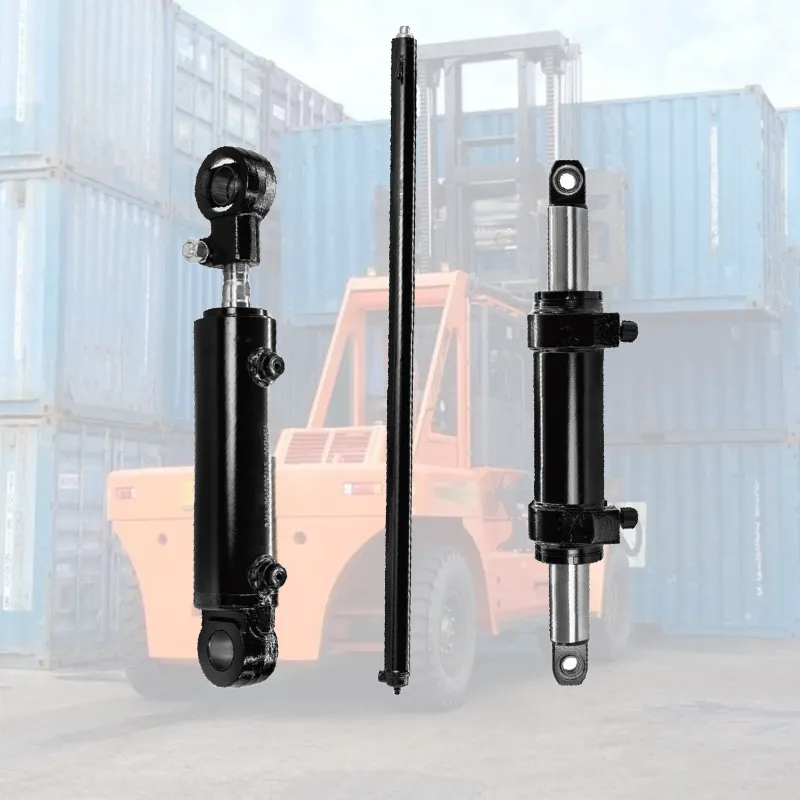
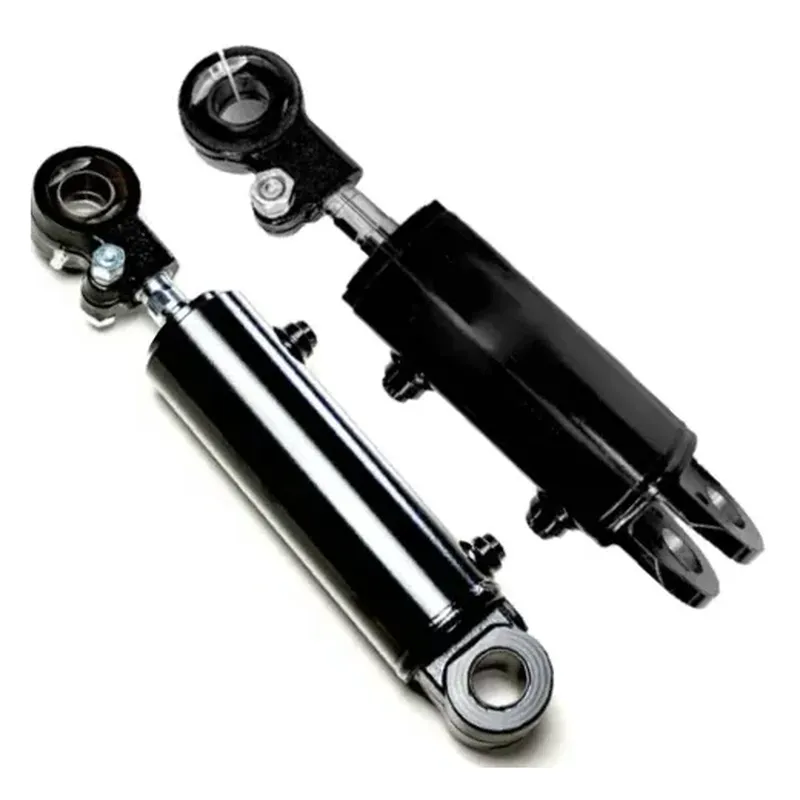
Our product line covers the full range of cylinder functions for forklifts rated from 10 to 50 tons: hydraulic lift cylinders, hydraulic tilt cylinders, hydraulic steering cylinders, and hydraulic side shift cylinders. Each one is manufactured in-house from raw bar stock to finished, tested assembly. We control the metallurgy, the honing, the chrome plating, the seal groove geometry, and the final pressure test. Nothing is outsourced to third-party shops with unverifiable quality.
What sets our cylinders apart is not a single feature but an engineering philosophy: design every component for the actual duty cycle the forklift will face, not the theoretical one printed in a brochure. That means thicker tube walls for shock resistance, deeper chrome layers for corrosion protection in port environments, and seal packages rated for a wider temperature band than the industry baseline.
Technical Specifications
Below are the customizable specification ranges for our large tonnage forklift hydraulic cylinders. Every parameter can be adjusted to match your exact machine model and operating conditions. If your application falls outside these ranges, contact our engineering team for a feasibility review.
Basic Specification Ranges
| Parameter | Lift Cylinder | Tilt Cylinder | Steering Cylinder |
|---|---|---|---|
| Bore Diameter | 80 – 200 mm | 80 – 180 mm | 50 – 120 mm |
| Rod Diameter | 50 – 140 mm | 45 – 120 mm | 30 – 80 mm |
| Stroke Length | 500 – 3000 mm | 100 – 350 mm | 80 – 300 mm |
| Operating Pressure | 16 – 30 MPa | 16 – 25 MPa | 14 – 21 MPa |
| Test Pressure | 1.5x Rated Pressure | 1.5x Rated Pressure | 1.5x Rated Pressure |
| Cylinder Action | Single / Double Acting | Double Acting | Double Acting |
| Retracted Length | Custom to OEM Drawing | Custom to OEM Drawing | Custom to OEM Drawing |
Mounting Options
| Mounting Type | Application |
|---|---|
| Pin-Eye / Clevis | Tilt cylinders, steering cylinders |
| Flange Mount (Square / Rectangular) | Lift cylinders, mast-mounted assemblies |
| Trunnion Mount | Oscillating load applications |
| Welded Lug / Side Lug | Frame-integrated cylinder installations |
| Custom OEM Configuration | Direct replacement for proprietary mounts |
Materials and Surface Treatment
| Component | Material / Treatment |
|---|---|
| Cylinder Tube | ST52 / 27SiMn Seamless Steel, Honed to Ra 0.2 – 0.4 um |
| Piston Rod | CK45 / 42CrMo4, Hard Chrome Plated (20 – 50 um) |
| Piston | Ductile Iron / Forged Steel, Nitride Hardened |
| Cylinder Head (Gland) | C45 Steel or Bronze Alloy |
| Seal Kit | Parker / Hallite / NOK – NBR, PU, PTFE Composite |
| External Finish | Shot Blasted + Zinc Primer + Polyurethane Topcoat |
Environmental Adaptability
| Parameter | Range / Rating |
|---|---|
| Operating Temperature | -30 C to +100 C |
| Hydraulic Fluid Compatibility | Mineral Oil (HLP), Biodegradable Fluids (HEES/HETG) |
| Corrosion Protection | Salt Spray Resistance 500+ Hours (ASTM B117) |
| Dust and Debris Protection | Triple-Lip Wiper Seal + Metal Scraper Ring |
| Vibration Resistance | Tested per ISO 10816 for mobile equipment |
How a Forklift Hydraulic Cylinder Works
Understanding the working principle helps operators diagnose problems faster and helps purchasing managers evaluate quality claims. A forklift hydraulic cylinder converts pressurized hydraulic fluid into linear mechanical force and motion. Here is the cycle broken down by function:
In a hydraulic lift cylinder, the hydraulic pump draws fluid from the reservoir and pushes it through the directional control valve into the cap-end port of the cylinder. This pressurized fluid acts on the full bore area of the hydraulic cylinder piston, generating an upward force that raises the mast carriage and the load. When the operator lowers the forks, the control valve redirects fluid flow, and the weight of the load plus carriage gravity pushes the piston back down, returning fluid to the reservoir through a flow control valve that governs descent speed.
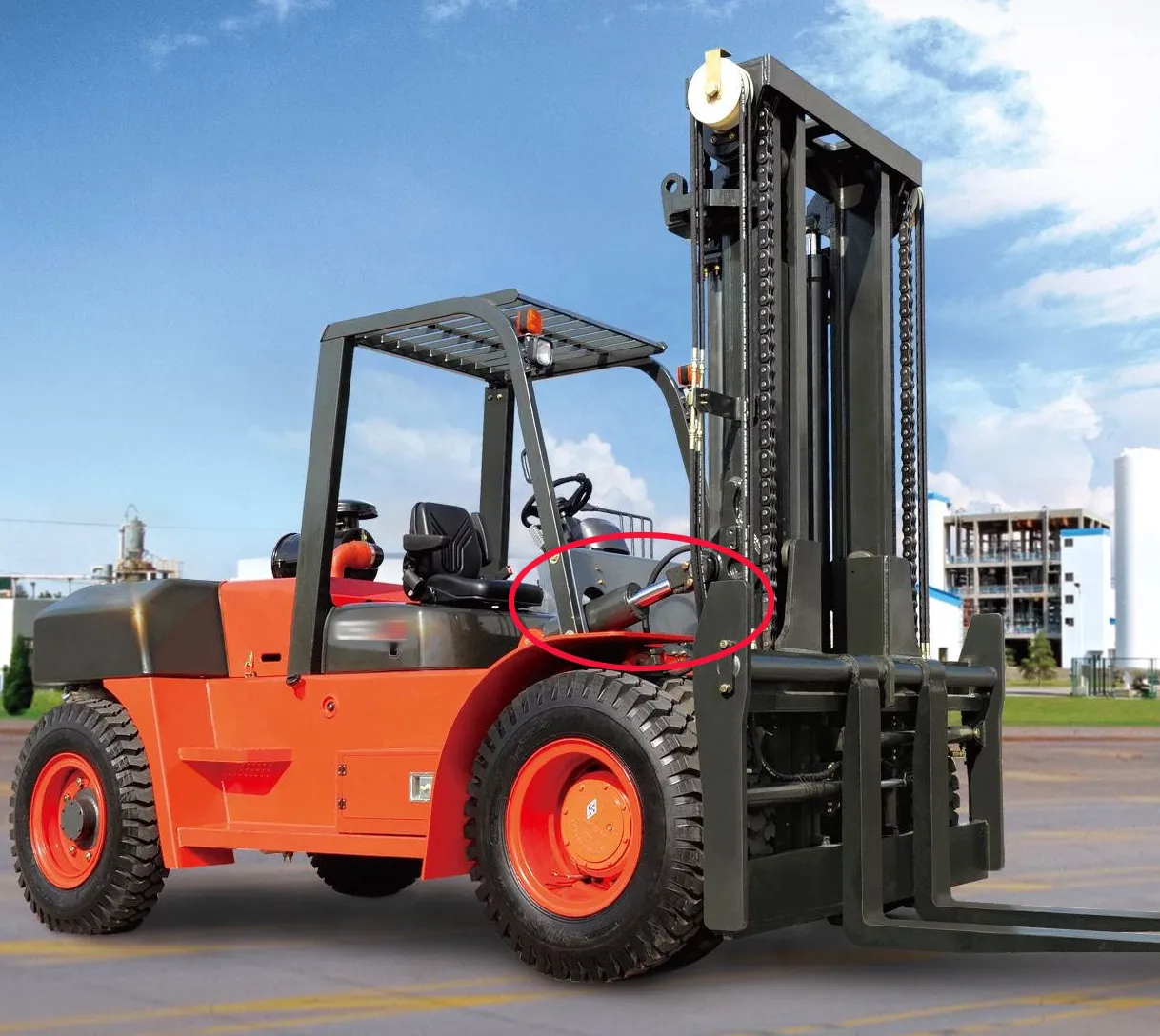
A hydraulic tilt cylinder operates as a double acting hydraulic cylinder. Fluid can be directed to either the cap-end or the rod-end port, allowing the mast to tilt forward and backward. This is critical for load engagement and transport stability. The tilt angle on large tonnage forklifts is typically 6 degrees forward and 10 to 12 degrees backward.
The hydraulic steering cylinder receives flow from a priority valve that guarantees steering response even when the lift circuit is under heavy demand. On articulated large tonnage forklifts, steering cylinders must react quickly and precisely to directional input, so internal leakage tolerances are especially tight.
Each of these cylinder types relies on a sealed chamber. The quality of the hydraulic cylinder seals, the surface finish of the bore, and the straightness of the piston rod determine whether the cylinder holds pressure efficiently or wastes energy through internal bypass leakage.

Compatible Brand Replacements
Disclaimer: All brand names mentioned below are the property of their respective owners. We reference them solely to assist buyers in identifying the correct replacement hydraulic cylinder for forklift applications. Our company is not affiliated with, endorsed by, or authorized by any of these manufacturers.
Our forklift hydraulic cylinders are designed as direct dimensional and performance replacements for cylinders used in the following large tonnage forklift brands:
- Toyota (10 – 25 ton diesel counterbalanced models)
- Hyster (H170FT through H360HD series)
- Komatsu (FD100 through FD500 series)
- Linde (H100 through H180 series)
- Kalmar (DCG series heavy counterbalanced handlers)
- Mitsubishi (FD100 through FD250 series)
- Clark (C500 heavy-duty platform)
- Caterpillar (DP100 through DP250 series)
- XCMG and Lonking heavy tonnage forklift platforms
We cross-reference OEM part numbers, match critical mounting dimensions, port locations, and stroke lengths, then validate fit through 3D modeling before cutting steel. If you have an OEM part number, send it over and we will confirm compatibility within 24 hours.
Core Technical Advantages
Ultra-Low Friction Seal Technology
Standard off-the-shelf seal kits are designed for general industrial use. We specify a composite PTFE-bronze piston seal paired with a polyurethane rod seal that together reduce breakaway pressure by up to 18 percent compared to conventional NBR seals. Lower friction means smoother lift initiation, less heat generation, and longer seal service life. On a forklift running 16-hour shifts, this translates to measurably lower hydraulic fluid temperature and fewer unplanned hydraulic cylinder seal replacement events per year.
High-Rigidity Cylinder Tube and Piston Rod Engineering
Cylinder tube ovality is held within 0.03 mm across the full bore length. This is achieved through deep-hole boring followed by roller burnishing and precision honing. The result is a bore surface with an Ra finish of 0.2 to 0.4 um, minimizing seal wear and internal leakage. Piston rods are induction hardened to 55-60 HRC before chrome plating to a minimum thickness of 25 um, with optional 50 um plating for extreme abrasion environments like quarry forklifts.
Thermal Stability and Fatigue Life Optimization
Our cylinders are designed for continuous operation at hydraulic fluid temperatures up to 100 degrees Celsius without seal degradation. Finite Element Analysis (FEA) is applied to every new cylinder design to identify stress concentration points, and wall thicknesses are adjusted to achieve a minimum fatigue life of 1,000,000 full-load cycles. In hot-climate markets like Mexico, the Middle East, and Southeast Asia, this thermal margin is not optional; it is a survival requirement.
Multi-Stage Contamination Defense
Particulate contamination is the leading cause of premature hydraulic cylinder failure in forklift applications. Our cylinders incorporate a triple-lip wiper seal backed by a hardened steel scraper ring to block external debris. Internally, the piston features anti-extrusion backup rings and tightly toleranced wear bands that maintain concentricity even under side-loading conditions.
Precision-Machined Cushioning System
End-of-stroke impact is one of the top causes of structural cracking in forklift mast cylinders. Our lift and tilt cylinders feature an integrated hydraulic cushion at both stroke ends. As the piston approaches its end position, a tapered spear enters the cushion cavity, progressively restricting fluid outflow and decelerating the piston smoothly. This eliminates metal-to-metal impact and extends the service life of the cylinder, the mast, and the forklift frame.
Corrosion-Resistant Architecture
Outdoor forklift operations and coastal port environments demand aggressive corrosion protection. Every hydraulic cylinder leaves our factory with a multi-layer coating system: zinc-rich primer followed by a polyurethane topcoat rated for 500-plus hours of salt spray resistance per ASTM B117. Rod chrome plating includes a micro-cracked finish that improves oil retention and resists pitting corrosion from chloride exposure.
Modular Seal Groove Design for Field Serviceability
When a seal eventually wears out, the last thing a maintenance team needs is a cylinder that requires factory disassembly. Our gland design features a bolt-on or threaded head with standardized groove geometry compatible with globally available seal profiles. A trained technician can complete a full forklift hydraulic cylinder rebuild on-site using common hand tools and our published forklift hydraulic cylinder seal replacement diagram.
Intelligent Port Configuration
Port placement and thread specification are customized to match the existing hydraulic plumbing of the target forklift. We offer BSP, NPT, SAE O-ring boss, and metric thread options, positioned at angles that eliminate the need for adapter fittings or custom hose routing. This saves installation time and removes potential leak points.

Manufacturing Process and Quality Control
Full In-House Manufacturing
We control every production step: raw material inspection, CNC turning, deep-hole boring, honing, welding, chrome plating, assembly, painting, and testing. There are no outsourced processes that could introduce variability. Our facility operates dedicated production lines for forklift hydraulic cylinders, separate from general industrial cylinder lines, because forklift duty cycles have specific requirements that general-purpose manufacturing floors tend to overlook.
100 Percent Factory Testing
Every cylinder undergoes a multi-stage test protocol before shipping:
- Proof pressure test at 1.5 times rated working pressure, held for a minimum of 3 minutes
- Internal leakage test measuring bypass flow across the piston at rated pressure; acceptance criterion is less than 0.5 ml per minute for cylinders under 150 mm bore
- External leakage test at rod seal and all port connections
- Stroke function test verifying smooth full extension and retraction without stick-slip
- Dimensional verification of all critical mounting and port dimensions against the customer-approved drawing
Certifications and Traceability
Our manufacturing system is certified to ISO 9001:2015. Every cylinder carries a unique serial number linked to a digital quality record that includes raw material mill certificates, dimensional inspection reports, test results, and the date of manufacture. This traceability is not a marketing feature; it is a requirement from our OEM and fleet management customers who need documentation for their own compliance audits. We also hold CE certification for cylinders destined for European markets.
Typical Industry Applications
Large tonnage forklifts serve a surprisingly wide range of industries. Here is where our hydraulic cylinders are working right now, often in conditions that would destroy a lesser product.
Warehousing and Distribution
High-volume distribution centers handling palletized goods above 10 tons per load rely on 15- to 25-ton counterbalanced forklifts for dock-to-rack transport. Cylinder reliability here is measured in uptime percentage, and any unplanned hydraulic cylinder repair event cascades into missed shipment windows.
Manufacturing
Steel mills, heavy machinery plants, and large-scale fabrication shops use 20- to 50-ton forklifts for moving raw material, tooling, and finished assemblies. Ambient temperatures near furnaces can exceed 50 degrees Celsius, putting extreme thermal stress on cylinder seals and hydraulic fluid.
Construction
Construction material yards and precast concrete plants use large forklifts to position steel beams, pipe bundles, and concrete elements. Dust, vibration, and uneven terrain make contamination defense and shock resistance critical cylinder attributes.
Agriculture
Large-scale agricultural operations and feed processing facilities use heavy forklifts for handling bulk bags, fertilizer pallets, and equipment. Seasonal peaks demand continuous operation, leaving zero tolerance for downtime caused by cylinder failure.
Retail and Wholesale
Major retail distribution hubs receiving full container loads use 10- to 15-ton forklifts for unloading and staging. The emphasis here is on fast cycle times and quiet operation, which requires well-functioning cushioning and low-friction seals.
Automotive
Automotive assembly plants and parts distribution centers move engine blocks, body panels, and stamped steel with large forklifts. The clean factory environment demands zero external leakage from every hydraulic oil cylinder on the floor.
Mining and Extractive Industries
Open-pit mines and mineral processing plants subject forklifts to extreme dust, vibration, and shock loading. Cylinders in these applications must survive conditions that are orders of magnitude harsher than warehouse use.
Oil and Gas
Refineries, pipeline construction staging areas, and offshore supply bases use heavy forklifts in environments where corrosion is constant and flammable atmospheres may be present. Cylinders must meet leak-free standards and, in some cases, ATEX-compatible material requirements.
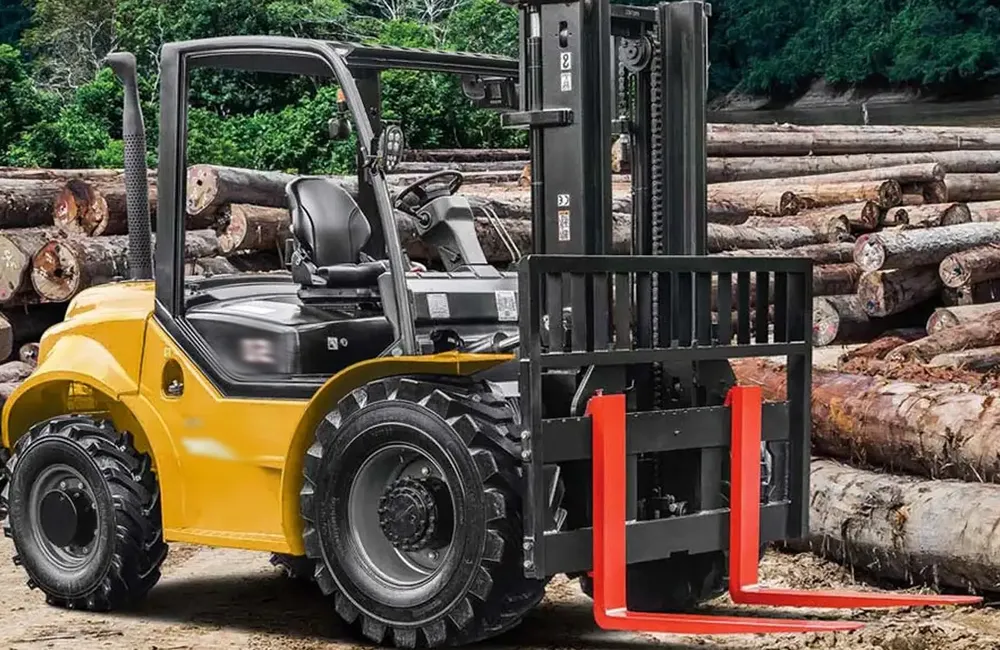
Forestry Industry
Log handling forklifts operate in wet, muddy conditions with massive shock loads from dropping and stacking timber. Chrome plating integrity and wiper seal performance are the difference between a cylinder that lasts three years and one that fails in six months.
Performance Comparison: Standard vs. Our High-Performance Cylinders
| Feature | Standard Hydraulic Cylinder | Our High-Performance Cylinder |
|---|---|---|
| Bore Surface Finish | Ra 0.4 – 0.8 um | Ra 0.2 – 0.4 um (Roller Burnished) |
| Chrome Plating Thickness | 15 – 20 um | 25 – 50 um (Micro-Cracked) |
| Seal Material | Standard NBR | PTFE-Bronze Composite + PU Rod Seal |
| Contamination Protection | Single Wiper Seal | Triple-Lip Wiper + Metal Scraper Ring |
| Fatigue Life (Full-Load Cycles) | 300,000 – 500,000 | 1,000,000+ |
| Operating Temp Range | -20 C to +80 C | -30 C to +100 C |
| Salt Spray Resistance | 200 Hours | 500+ Hours (ASTM B117) |
| End-of-Stroke Cushioning | Not Standard | Integrated Tapered Spear Cushion |
| Factory Test Protocol | Pressure Test Only | 5-Stage Test (Pressure, Leakage, Function, Dimensional) |
| Traceability | Batch-Level | Individual Serial Number with Digital Record |
Real-World Customer Case Studies
Case 1: Steel Distribution Center – Monterrey, Mexico
Customer: A major flat steel distributor operating a fleet of twelve 25-ton Hyster counterbalanced forklifts.
Challenge: Lift cylinder rod seals were failing every 4 to 5 months due to ambient heat and fine iron dust. Each failure required 2 days of downtime per unit, and seal kits from the OEM dealer had a 6-week lead time.
How They Found Us: Their maintenance manager searched for aftermarket forklift hydraulic cylinders for sale compatible with Hyster H250HD models and found our product page through Google.
Result: We supplied 24 replacement lift cylinders with upgraded PTFE composite seals and 50 um chrome rods. After 14 months in service (as of March 2026), not a single seal failure has been reported. Downtime from cylinder issues dropped to zero.
“We used to budget for 20 seal kits a year across our fleet. Last year we bought zero. The cylinders paid for themselves in 5 months.” – Maintenance Supervisor, Monterrey facility
Case 2: Container Port – Lazaro Cardenas, Mexico
Customer: A port logistics company handling containerized cargo with 16-ton Kalmar counterbalanced forklifts.
Challenge: Steering cylinders were corroding within 8 months due to salt air exposure. The OEM replacement cost was prohibitive at volume.
How They Found Us: Their procurement team was referred by a hydraulic hose supplier in Guadalajara who had visited our factory.
Result: We delivered 10 steering cylinders with enhanced marine-grade chrome and salt-spray-rated coatings in July 2025. After 8 months of port operation, corrosion inspection showed zero pitting. The customer placed a follow-up order for tilt cylinders in February 2026.
“The OEM wanted $1,800 per cylinder. These perform better and cost 40 percent less. We should have switched sooner.” – Fleet Manager
Case 3: Mining Operation – Sonora, Mexico
Customer: A copper mine using 30-ton Komatsu forklifts for moving equipment and materials in open-pit conditions.
Challenge: Tilt cylinders were experiencing rod scoring within 6 months from fine silica dust. Each rebuild required removing the cylinder from the mast, a 4-hour job with a crane.
How They Found Us: Their equipment engineer contacted us through our contact page after finding our website during a search for heavy-duty hydraulic tilt cylinder suppliers.
Result: We supplied custom tilt cylinders with triple-lip wipers, metal scraper rings, and 50 um hard chrome rods. Inspection after 12 months of continuous operation showed rod surface in near-new condition. The customer estimated savings of $35,000 per year in avoided rebuild costs across their 5-unit fleet.
“I pulled the rod out at the 12-month mark expecting to see scoring. It looked like it just came out of the box. That sold me completely.” – Equipment Engineer
Case 4: Beverage Distribution – Guadalajara, Mexico
Customer: A national beverage distributor with a fleet of 12-ton Toyota forklifts operating in three regional warehouses.
Challenge: Lift cylinders were developing internal leakage after 18 months, causing slow drift-down of loaded forks, a safety concern during stacking at height.
How They Found Us: The warehouse director attended a material handling trade show in Mexico City where one of our distribution partners displayed our cylinder cross-section cutaway model.
Result: We replaced 8 lift cylinders. Internal leakage testing at the 18-month mark showed bypass flow well within specification. The drift-down issue was completely eliminated, and the safety team closed the related corrective action report.
“The drift problem was a safety audit finding we could not close for two years. These cylinders closed it permanently.” – Safety Director
Case 5: Forestry Products – Durango, Mexico
Customer: A sawmill and timber processing company using 20-ton forklifts with log clamp attachments.
Challenge: Side shift and tilt cylinders were failing frequently from bark, sap, and moisture intrusion. The remote location made quick hydraulic cylinder repair impractical.
How They Found Us: A Caterpillar dealership service technician recommended our brand after seeing our cylinders perform well on another forestry customer’s fleet.
Result: We supplied a complete cylinder set (lift, tilt, side shift) with forestry-grade contamination protection. After 10 months of continuous logging season operation, no cylinder required service. The customer reported this was the first full season in five years without a cylinder-related work stoppage.
“We operate 45 minutes from the nearest hydraulic shop. A cylinder that does not break is worth more to us than a cheap one we have to keep rebuilding.” – Operations Manager
Case 6: Automotive Parts Manufacturer – Puebla, Mexico
Customer: A Tier 1 automotive parts supplier using 15-ton Mitsubishi forklifts inside a climate-controlled stamping plant.
Challenge: The plant had a strict zero-leak policy for all hydraulic equipment on the production floor to protect finished automotive body panels. OEM cylinders were developing minor rod seal weeps after 12 months.
How They Found Us: Their hydraulic systems engineer emailed us a detailed technical specification and asked for a formal quotation with test certificates included.
Result: We delivered 6 lift cylinders and 6 tilt cylinders with premium PU rod seals and polished gland surfaces. At the 20-month inspection, zero external leakage was detected on any unit. The plant passed its annual customer audit without a single hydraulic-related finding.
“Our automotive customer audits are ruthless about fluid leaks near finished parts. These cylinders gave us one less thing to worry about during audit season.” – Plant Engineer
Common Forklift Hydraulic Cylinder Troubleshooting
Before replacing a cylinder, rule out these common issues. A systematic approach saves time and money.
Slow or Weak Lift
Check hydraulic fluid level and condition first. Cloudy or foamy fluid indicates air intrusion or water contamination. If fluid is clean, test system pressure at the pump outlet. Low pressure points to a pump issue, not a cylinder problem. If pressure is correct but lift is still slow, the cylinder likely has internal leakage past the piston seals and needs a rebuild or replacement.
Fork Drift-Down Under Load
This is almost always caused by internal seal bypass in the lift cylinder or a leaking holding valve. Isolate the cylinder by capping the port lines and monitoring for position change. If drift continues with lines capped, the cylinder piston seal has failed. Refer to the forklift hydraulic cylinder diagram in your service manual to identify the correct seal profile for replacement.
External Oil Leakage at Rod Seal
Minor weeping can sometimes be resolved by cleaning debris from the rod surface and inspecting the wiper seal. If the rod shows visible scoring, scratching, or chrome peeling, the rod must be re-chromed or the cylinder replaced. Continuing to operate with a damaged rod will destroy the new seal within days.
Jerky or Erratic Cylinder Movement
Air trapped in the cylinder is the most common cause. Bleed the circuit by cycling the cylinder through its full stroke several times with no load. If the problem persists, inspect for a cracked cylinder tube or damaged port fitting that is allowing air ingress.
Excessive Heat at the Cylinder
A cylinder that is hot to the touch (above 70 C on the external surface) usually indicates excessive internal leakage or a restricted return line creating back pressure. Internal leakage converts hydraulic energy into heat instead of mechanical work. Test and replace the piston seal assembly.
How to Select the Right Hydraulic Cylinder for Your Forklift
Choosing the correct replacement hydraulic cylinder for forklift applications requires more than matching a part number. Here is a structured approach that will get you to the right specification efficiently:
Step 1: Identify the Cylinder Function. Determine whether you need a lift, tilt, steering, or side shift cylinder. Each has a different bore-to-rod ratio, stroke, mounting configuration, and pressure rating.
Step 2: Gather the OEM Part Number. This is the fastest path to a correct replacement. The OEM part number is usually stamped on the cylinder body or listed in the forklift service manual. If you cannot find it, measure the bore, rod diameter, stroke, and retracted length, and photograph the mounting configuration.
Step 3: Define Your Operating Environment. A cylinder for an air-conditioned warehouse has very different requirements than one for a coastal port or an open-pit mine. Tell your supplier about temperature extremes, dust exposure, corrosive agents, and daily operating hours.
Step 4: Specify Seal and Surface Requirements. If your current cylinders are failing prematurely, the root cause is usually inadequate seal material or insufficient rod surface protection for the environment. Upgrading to a PTFE composite seal and thicker chrome layer often solves chronic failure patterns.
Step 5: Request Test Documentation. Any credible hydraulic cylinder manufacturer will provide a test report with each cylinder showing proof pressure results, leakage rates, and dimensional conformance. If a supplier cannot or will not provide this, look elsewhere.
Step 6: Evaluate After-Sales Support. Can the supplier provide a forklift hydraulic cylinder seal replacement diagram and a recommended spare seal kit? Will they support you with technical guidance if an issue arises in the field? A cylinder is a long-term relationship, not a one-time purchase.

Frequently Asked Questions
What is the typical lead time for a custom hydraulic cylinder for large tonnage forklift models?
Standard configurations ship within 15 to 20 business days from order confirmation. Fully custom designs requiring new drawings and prototyping typically take 25 to 35 business days. If you have an urgent breakdown situation, contact us directly and we will check if we can expedite from existing semi-finished stock.
Can I order just hydraulic cylinder seals and parts instead of a complete cylinder?
Yes. We supply hydraulic cylinder parts including complete seal kits, piston assemblies, gland assemblies, and individual seals matched to your cylinder serial number. For a forklift hydraulic cylinder rebuild, we provide exploded-view diagrams and torque specifications so your technicians can perform the work on-site.
How do I know if my forklift hydraulic cylinder needs repair or full replacement?
If the cylinder tube bore is scored, the rod has deep scratches or chrome loss, or the mounting eyes have excessive wear, a full replacement is more cost-effective than repair. If the bore and rod are in good condition and the issue is limited to seal wear, a rebuild with new forklift hydraulic cylinder seals is usually sufficient. We offer free assessment if you send us photographs and measurements.
Do you supply both single acting and double acting hydraulic cylinders for forklifts?
We manufacture both types. Lift cylinders for gravity-return mast systems are available as single acting hydraulic cylinders. Tilt, steering, and side shift cylinders are double acting hydraulic cylinders with fluid ports on both the cap and rod ends for full bidirectional force control.
What minimum order quantity do you require for forklift hydraulic cylinders?
There is no rigid minimum. We regularly fulfill orders from a single prototype cylinder to production batches of 500 units. Pricing is volume-tiered, so larger orders receive better per-unit cost. For fleet operators needing ongoing supply, we offer annual blanket purchase agreements with scheduled deliveries.
How to remove a hydraulic cylinder from a forklift safely?
First, lower the mast fully and relieve all residual hydraulic pressure by cycling the control lever with the engine off. Disconnect the hydraulic lines and cap them immediately to prevent fluid loss and contamination. Support the mast or attachment with a chain or overhead crane before unbolting the cylinder mounting pins. Refer to the forklift service manual for model-specific procedures, as pin retention methods vary. If you need a forklift hydraulic cylinder diagram for your specific machine, we can often provide one when you share the model number.
Are your cylinders compatible with biodegradable hydraulic fluids?
Yes. Our standard seal packages are compatible with both mineral-based hydraulic oils (HLP series) and biodegradable fluids including synthetic esters (HEES) and natural esters (HETG). If you are operating in an environmentally sensitive area that requires bio-fluid, let us know at the quotation stage so we can confirm the seal compound selection.
What warranty do you offer on forklift hydraulic cylinders?
We provide a 12-month warranty from the date of delivery covering defects in materials and workmanship. For customers who purchase extended service agreements, warranty coverage extends to 18 or 24 months depending on the contract tier. Warranty claims are supported by our serial number traceability system, which links every cylinder to its full manufacturing and test history.
Can you match hydraulic cylinder specifications from a competitor or OEM drawing?
This is one of our core services. Send us the OEM part number, a dimensioned drawing, or even clear photographs with key measurements marked, and our engineering team will prepare a cross-reference proposal. We have an internal database covering thousands of forklift hydraulic cylinder OEM part numbers from major brands, which allows us to confirm fit before manufacturing begins.
Do you ship hydraulic cylinders to Mexico and what are the delivery terms?
We ship to Mexico regularly and have established logistics channels for both full container loads (FCL) and less-than-container loads (LCL) to major Mexican ports including Manzanillo, Lazaro Cardenas, and Veracruz. Standard delivery terms are FOB or CIF. Door-to-door delivery with customs clearance support is available through our freight forwarding partners. Transit time from factory to Mexican port is typically 25 to 30 days by sea.
Ready to Upgrade Your Forklift Hydraulic Cylinders?
Whether you need a single replacement cylinder or a full fleet conversion, our engineering team is ready to deliver a solution built for your exact application. Share your forklift model, OEM part number, or operating requirements, and we will respond with a detailed technical proposal within 48 hours.